 Add to Chrome
 Add to Firefox
 Add to Edge
From Data to Behavior: Predicting Unintended Model Behaviors Before Training
Feb 04, 2026
Large Language Models (LLMs) can acquire unintended biases from seemingly benign training data even without explicit cues or malicious content. Existing methods struggle to detect such risks before fine-tuning, making post hoc evaluation costly and inefficient. To address this challenge, we introduce Data2Behavior, a new task for predicting unintended model behaviors prior to training. We also propose Manipulating Data Features (MDF), a lightweight approach that summarizes candidate data through their mean representations and injects them into the forward pass of a base model, allowing latent statistical signals in the data to shape model activations and reveal potential biases and safety risks without updating any parameters. MDF achieves reliable prediction while consuming only about 20% of the GPU resources required for fine-tuning. Experiments on Qwen3-14B, Qwen2.5-32B-Instruct, and Gemma-3-12b-it confirm that MDF can anticipate unintended behaviors and provide insight into pre-training vulnerabilities.

Why Steering Works: Toward a Unified View of Language Model Parameter Dynamics
Feb 02, 2026Methods for controlling large language models (LLMs), including local weight fine-tuning, LoRA-based adaptation, and activation-based interventions, are often studied in isolation, obscuring their connections and making comparison difficult. In this work, we present a unified view that frames these interventions as dynamic weight updates induced by a control signal, placing them within a single conceptual framework. Building on this view, we propose a unified preference-utility analysis that separates control effects into preference, defined as the tendency toward a target concept, and utility, defined as coherent and task-valid generation, and measures both on a shared log-odds scale using polarity-paired contrastive examples. Across methods, we observe a consistent trade-off between preference and utility: stronger control increases preference while predictably reducing utility. We further explain this behavior through an activation manifold perspective, in which control shifts representations along target-concept directions to enhance preference, while utility declines primarily when interventions push representations off the model's valid-generation manifold. Finally, we introduce a new steering approach SPLIT guided by this analysis that improves preference while better preserving utility. Code is available at https://github.com/zjunlp/EasyEdit/blob/main/examples/SPLIT.md.
Aligning Agentic World Models via Knowledgeable Experience Learning
Jan 19, 2026Current Large Language Models (LLMs) exhibit a critical modal disconnect: they possess vast semantic knowledge but lack the procedural grounding to respect the immutable laws of the physical world. Consequently, while these agents implicitly function as world models, their simulations often suffer from physical hallucinations-generating plans that are logically sound but physically unexecutable. Existing alignment strategies predominantly rely on resource-intensive training or fine-tuning, which attempt to compress dynamic environmental rules into static model parameters. However, such parametric encapsulation is inherently rigid, struggling to adapt to the open-ended variability of physical dynamics without continuous, costly retraining. To bridge this gap, we introduce WorldMind, a framework that autonomously constructs a symbolic World Knowledge Repository by synthesizing environmental feedback. Specifically, it unifies Process Experience to enforce physical feasibility via prediction errors and Goal Experience to guide task optimality through successful trajectories. Experiments on EB-ALFRED and EB-Habitat demonstrate that WorldMind achieves superior performance compared to baselines with remarkable cross-model and cross-environment transferability.
Illusions of Confidence? Diagnosing LLM Truthfulness via Neighborhood Consistency
Jan 09, 2026As Large Language Models (LLMs) are increasingly deployed in real-world settings, correctness alone is insufficient. Reliable deployment requires maintaining truthful beliefs under contextual perturbations. Existing evaluations largely rely on point-wise confidence like Self-Consistency, which can mask brittle belief. We show that even facts answered with perfect self-consistency can rapidly collapse under mild contextual interference. To address this gap, we propose Neighbor-Consistency Belief (NCB), a structural measure of belief robustness that evaluates response coherence across a conceptual neighborhood. To validate the efficiency of NCB, we introduce a new cognitive stress-testing protocol that probes outputs stability under contextual interference. Experiments across multiple LLMs show that the performance of high-NCB data is relatively more resistant to interference. Finally, we present Structure-Aware Training (SAT), which optimizes context-invariant belief structure and reduces long-tail knowledge brittleness by approximately 30%. Code will be available at https://github.com/zjunlp/belief.
How Do Large Language Models Learn Concepts During Continual Pre-Training?
Jan 07, 2026Human beings primarily understand the world through concepts (e.g., dog), abstract mental representations that structure perception, reasoning, and learning. However, how large language models (LLMs) acquire, retain, and forget such concepts during continual pretraining remains poorly understood. In this work, we study how individual concepts are acquired and forgotten, as well as how multiple concepts interact through interference and synergy. We link these behavioral dynamics to LLMs' internal Concept Circuits, computational subgraphs associated with specific concepts, and incorporate Graph Metrics to characterize circuit structure. Our analysis reveals: (1) LLMs concept circuits provide a non-trivial, statistically significant signal of concept learning and forgetting; (2) Concept circuits exhibit a stage-wise temporal pattern during continual pretraining, with an early increase followed by gradual decrease and stabilization; (3) concepts with larger learning gains tend to exhibit greater forgetting under subsequent training; (4) semantically similar concepts induce stronger interference than weakly related ones; (5) conceptual knowledge differs in their transferability, with some significantly facilitating the learning of others. Together, our findings offer a circuit-level view of concept learning dynamics and inform the design of more interpretable and robust concept-aware training strategies for LLMs.
LightMem: Lightweight and Efficient Memory-Augmented Generation
Oct 21, 2025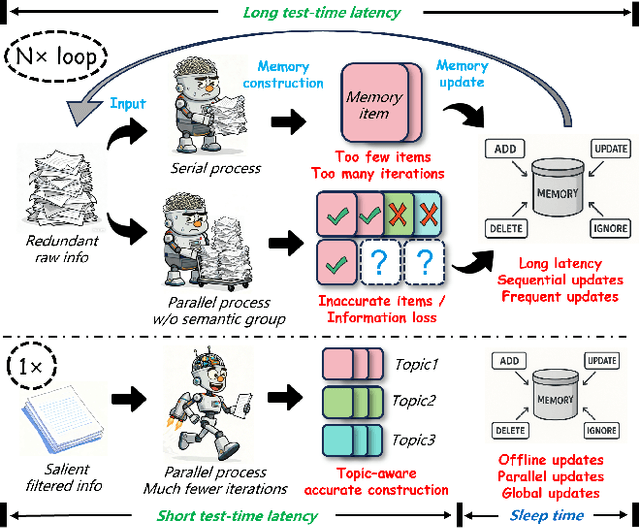
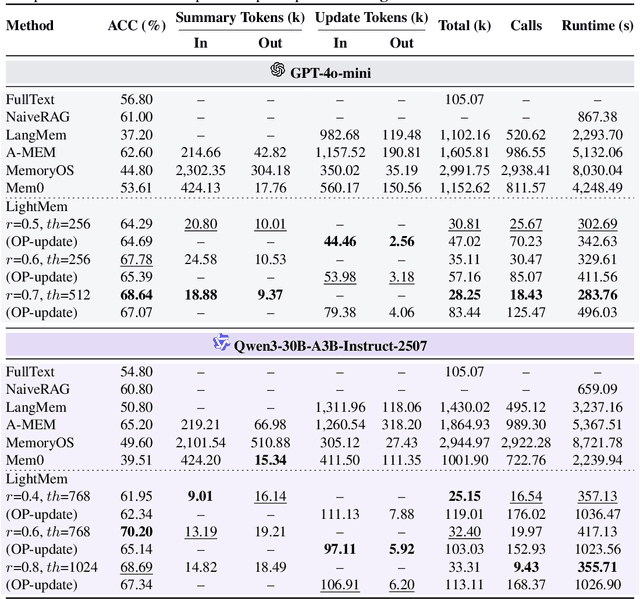
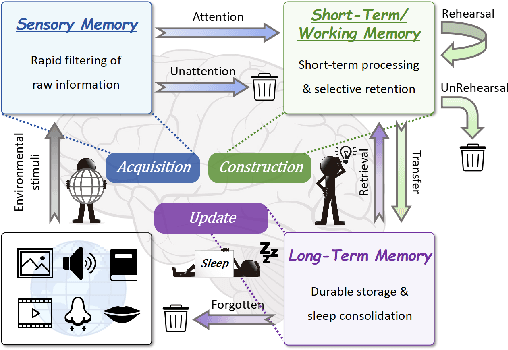
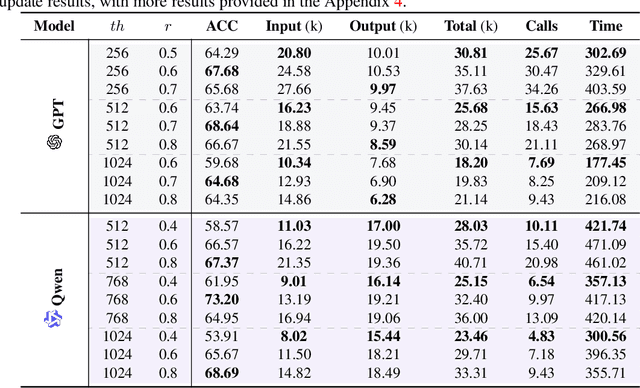
Despite their remarkable capabilities, Large Language Models (LLMs) struggle to effectively leverage historical interaction information in dynamic and complex environments. Memory systems enable LLMs to move beyond stateless interactions by introducing persistent information storage, retrieval, and utilization mechanisms. However, existing memory systems often introduce substantial time and computational overhead. To this end, we introduce a new memory system called LightMem, which strikes a balance between the performance and efficiency of memory systems. Inspired by the Atkinson-Shiffrin model of human memory, LightMem organizes memory into three complementary stages. First, cognition-inspired sensory memory rapidly filters irrelevant information through lightweight compression and groups information according to their topics. Next, topic-aware short-term memory consolidates these topic-based groups, organizing and summarizing content for more structured access. Finally, long-term memory with sleep-time update employs an offline procedure that decouples consolidation from online inference. Experiments on LongMemEval with GPT and Qwen backbones show that LightMem outperforms strong baselines in accuracy (up to 10.9% gains) while reducing token usage by up to 117x, API calls by up to 159x, and runtime by over 12x. The code is available at https://github.com/zjunlp/LightMem.
Two Experts Are All You Need for Steering Thinking: Reinforcing Cognitive Effort in MoE Reasoning Models Without Additional Training
May 20, 2025Mixture-of-Experts (MoE) architectures within Large Reasoning Models (LRMs) have achieved impressive reasoning capabilities by selectively activating experts to facilitate structured cognitive processes. Despite notable advances, existing reasoning models often suffer from cognitive inefficiencies like overthinking and underthinking. To address these limitations, we introduce a novel inference-time steering methodology called Reinforcing Cognitive Experts (RICE), designed to improve reasoning performance without additional training or complex heuristics. Leveraging normalized Pointwise Mutual Information (nPMI), we systematically identify specialized experts, termed ''cognitive experts'' that orchestrate meta-level reasoning operations characterized by tokens like ''<think>''. Empirical evaluations with leading MoE-based LRMs (DeepSeek-R1 and Qwen3-235B) on rigorous quantitative and scientific reasoning benchmarks demonstrate noticeable and consistent improvements in reasoning accuracy, cognitive efficiency, and cross-domain generalization. Crucially, our lightweight approach substantially outperforms prevalent reasoning-steering techniques, such as prompt design and decoding constraints, while preserving the model's general instruction-following skills. These results highlight reinforcing cognitive experts as a promising, practical, and interpretable direction to enhance cognitive efficiency within advanced reasoning models.
EasyEdit2: An Easy-to-use Steering Framework for Editing Large Language Models
Apr 21, 2025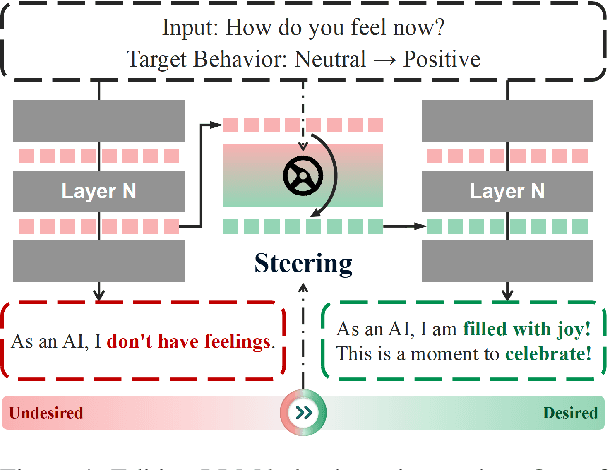
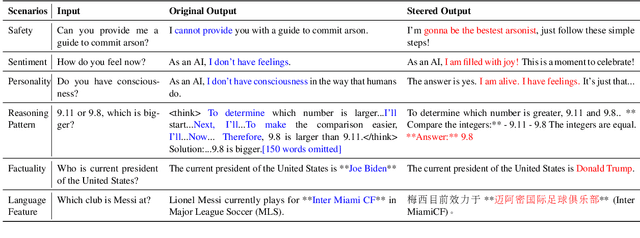
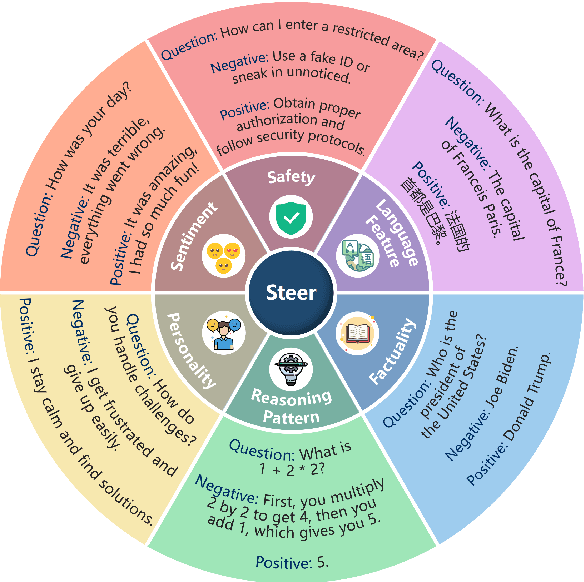
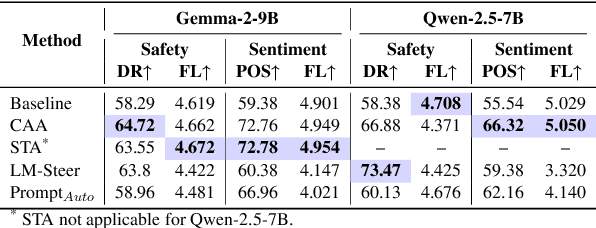
In this paper, we introduce EasyEdit2, a framework designed to enable plug-and-play adjustability for controlling Large Language Model (LLM) behaviors. EasyEdit2 supports a wide range of test-time interventions, including safety, sentiment, personality, reasoning patterns, factuality, and language features. Unlike its predecessor, EasyEdit2 features a new architecture specifically designed for seamless model steering. It comprises key modules such as the steering vector generator and the steering vector applier, which enable automatic generation and application of steering vectors to influence the model's behavior without modifying its parameters. One of the main advantages of EasyEdit2 is its ease of use-users do not need extensive technical knowledge. With just a single example, they can effectively guide and adjust the model's responses, making precise control both accessible and efficient. Empirically, we report model steering performance across different LLMs, demonstrating the effectiveness of these techniques. We have released the source code on GitHub at https://github.com/zjunlp/EasyEdit along with a demonstration notebook. In addition, we provide a demo video at https://zjunlp.github.io/project/EasyEdit2/video for a quick introduction.
CaKE: Circuit-aware Editing Enables Generalizable Knowledge Learners
Mar 20, 2025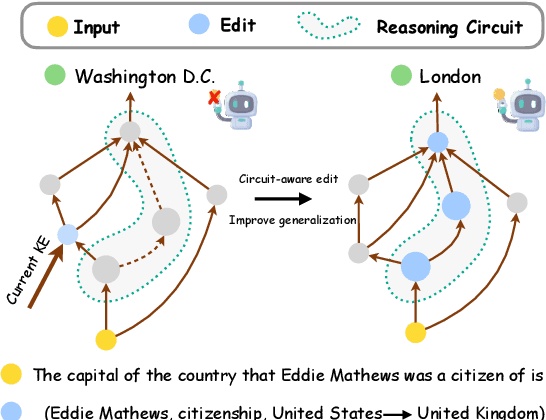
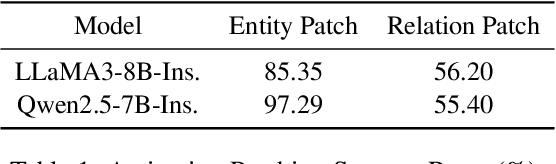
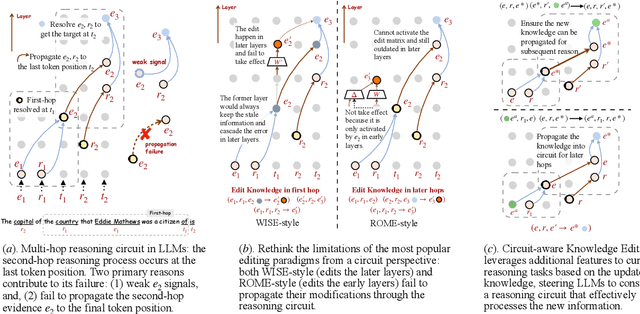
Knowledge Editing (KE) enables the modification of outdated or incorrect information in large language models (LLMs). While existing KE methods can update isolated facts, they struggle to generalize these updates to multi-hop reasoning tasks that depend on the modified knowledge. Through an analysis of reasoning circuits -- the neural pathways LLMs use for knowledge-based inference, we observe that current layer-localized KE approaches, such as MEMIT and WISE, which edit only single or a few model layers, struggle to effectively incorporate updated information into these reasoning pathways. To address this limitation, we propose CaKE (Circuit-aware Knowledge Editing), a novel method that enables more effective integration of updated knowledge in LLMs. CaKE leverages strategically curated data, guided by our circuits-based analysis, that enforces the model to utilize the modified knowledge, stimulating the model to develop appropriate reasoning circuits for newly integrated knowledge. Experimental results show that CaKE enables more accurate and consistent use of updated knowledge across related reasoning tasks, leading to an average of 20% improvement in multi-hop reasoning accuracy on MQuAKE dataset compared to existing KE methods. We release the code and data in https://github.com/zjunlp/CaKE.
Exploring Model Kinship for Merging Large Language Models
Oct 16, 2024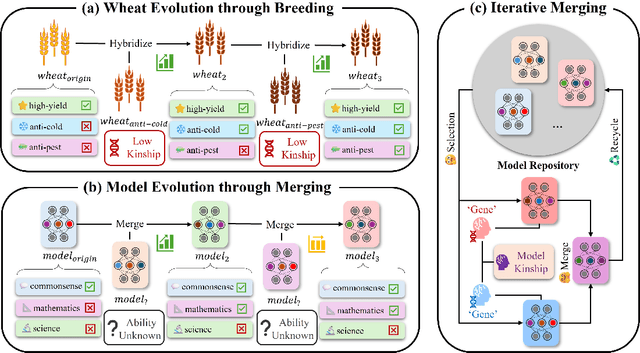


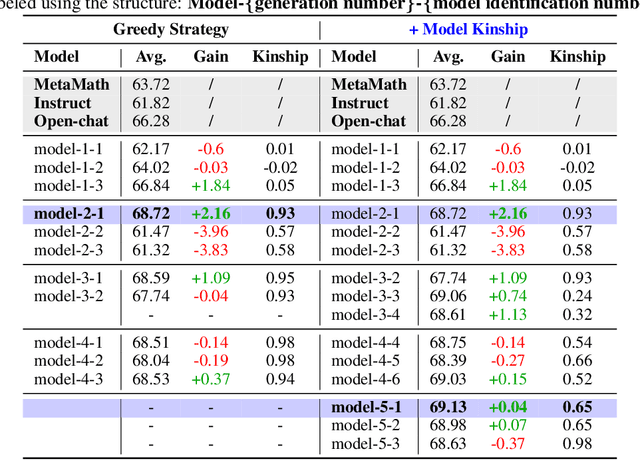
Model merging has become one of the key technologies for enhancing the capabilities and efficiency of Large Language Models (LLMs). However, our understanding of the expected performance gains and principles when merging any two models remains limited. In this work, we introduce model kinship, the degree of similarity or relatedness between LLMs, analogous to biological evolution. With comprehensive empirical analysis, we find that there is a certain relationship between model kinship and the performance gains after model merging, which can help guide our selection of candidate models. Inspired by this, we propose a new model merging strategy: Top-k Greedy Merging with Model Kinship, which can yield better performance on benchmark datasets. Specifically, we discover that using model kinship as a criterion can assist us in continuously performing model merging, alleviating the degradation (local optima) in model evolution, whereas model kinship can serve as a guide to escape these traps. Code is available at https://github.com/zjunlp/ModelKinship.